
Meet Magento UK 2026 offered one of the clearest indications yet of where Magento and Adobe Commerce are heading.
AI is moving beyond content generation and into product discovery and purchasing. Adobe is building Commerce around increasingly agentic shopping experiences, while merchants are being pushed towards better structured catalogue data, more extensible architectures and faster storefronts.
For Magento merchants, the implications go considerably further than adopting another AI tool.
The way products are discovered, understood and purchased is beginning to change — and catalogue structure, content quality, site performance and technical architecture could become increasingly important to both human customers and AI agents.
Meet Magento UK 2026, held at The Mermaid in London on 7 July, brought together retailers, agencies, technology providers and members of the Magento and Adobe Commerce community.
Across the talks, one theme was particularly apparent: the future of commerce isn’t about adopting a single new technology. It is about bringing content, data, AI, commerce and flexible technical architecture together to create better customer experiences.
AI is moving from conversation to commerce
Artificial intelligence was one of the biggest themes throughout Meet Magento UK 2026.
But the conversation has moved beyond using generative AI simply to create product descriptions, advertising copy or images.
The more significant development is AI beginning to participate directly in the shopping journey.
Agentic AI, conversational commerce, semantic search, LLM-driven product discovery and AI-powered merchandising all point towards a future where customers may not always interact with an ecommerce store in the traditional way.
Instead of navigating menus, filtering categories and trying different search terms, a shopper may simply describe what they need:
“I need a waterproof jacket suitable for a three-day walking holiday in Scotland in October.”
The challenge for a commerce platform is then to understand the intent, product requirements and context behind that request and surface appropriate products.
For merchants, this creates an important new challenge.
It may no longer be enough for a product to be discoverable on your website or indexed by a search engine. Product information increasingly needs to be understandable to AI systems as well.
What is agentic commerce?
Agentic commerce takes conversational shopping a step further.
Rather than an AI system simply answering questions about products, an AI agent can potentially participate in parts of the shopping journey on behalf of the customer — discovering products, comparing options, checking availability, managing a basket and eventually helping complete a transaction.
Adobe Commerce is already moving in this direction.
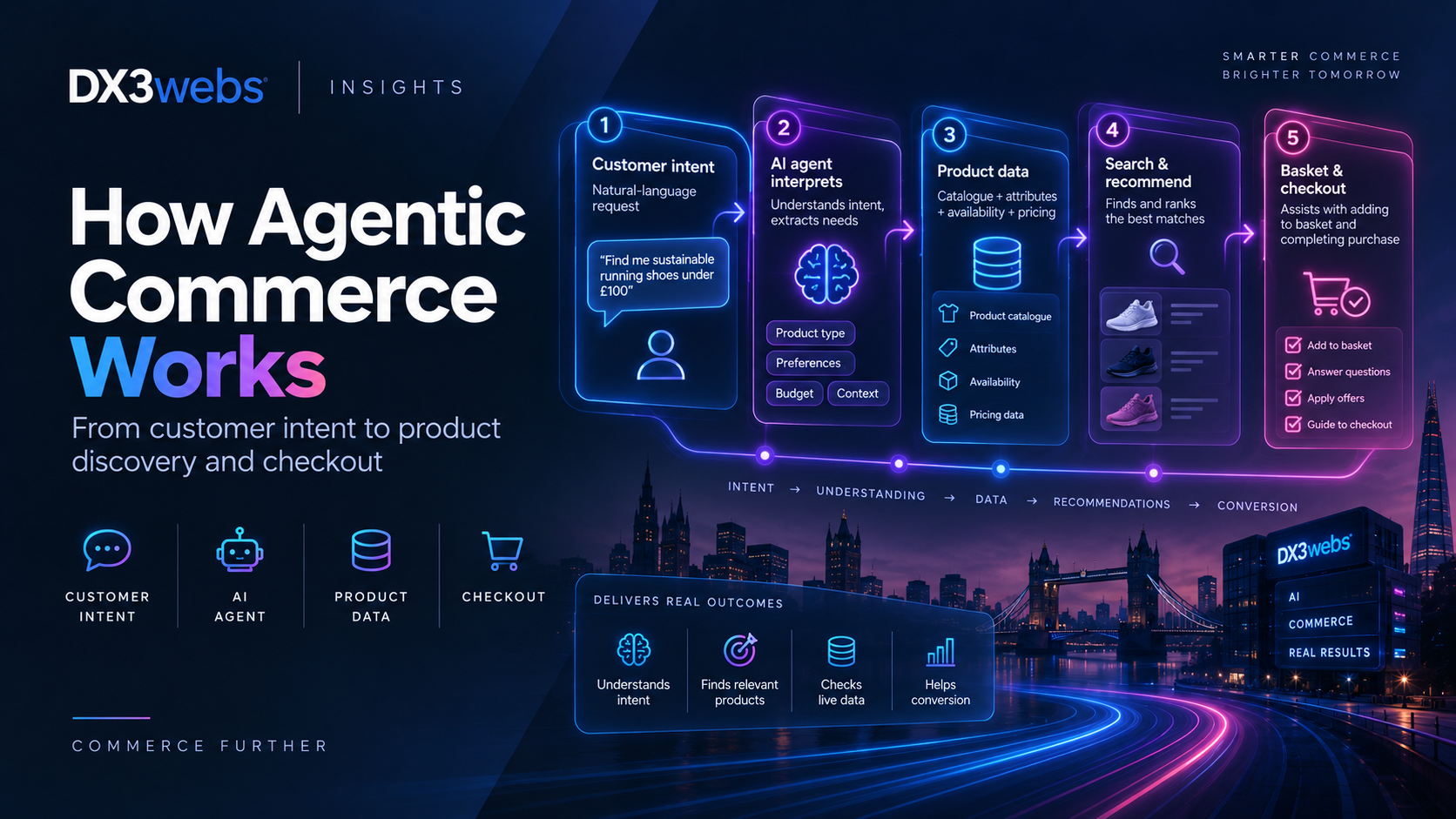
Adobe’s Shop Front Model Context Protocol (MCP) server is designed to give compatible AI systems controlled access to live Commerce services and data, including product catalogue information, pricing, inventory and basket functionality.
Adobe is also developing conversational shopping capabilities through technologies such as Brand Concierge.
This does not mean the conventional ecommerce storefront is about to disappear.
It does mean that merchants need to consider a world in which the website is no longer the only interface through which customers discover and interact with their catalogue.
For Magento and Adobe Commerce businesses, an AI-ready store therefore starts with something surprisingly familiar: accurate data, predictable systems, reliable APIs and a well-engineered ecommerce platform.
Adobe Commerce search is becoming semantic
Traditional ecommerce search largely depends on customers knowing what to type and merchants ensuring their catalogue contains matching terms.
Semantic search changes that relationship by attempting to understand meaning and context rather than relying solely on literal keyword matches.
This is no longer theoretical for Adobe Commerce.
Adobe made semantic search generally available for Adobe Commerce Live Search in June 2026 for supported Adobe Commerce installations.
Instead of simply matching words, semantic search can interpret the intent behind natural-language queries and attempt to find products that satisfy that intent.
A customer may not know a product name, SKU or even the terminology the merchant uses.
They might instead search for a problem they are trying to solve:
“comfortable shoes for standing all day”
or:
“something warm for a winter hike”.
For merchants, the opportunity is to move from simply matching keywords to helping customers identify the product that best meets their actual requirements.
It can also help reduce one of ecommerce search’s most frustrating outcomes: the zero-results page caused by a customer’s terminology differing from the terminology used within the catalogue.
Product catalogue data is becoming an AI asset
A well-structured catalogue has always been important in ecommerce.
AI makes its importance even more obvious.
Product names, descriptions, attributes, specifications, categories, relationships, imagery and supporting content all contribute to how effectively products can be understood and surfaced.
That means catalogue management should no longer be seen purely as an operational task.
Product data is increasingly part of the technical infrastructure powering search, recommendations, merchandising and AI-driven commerce.
A product with a vague description, missing attributes and inconsistent specifications gives humans, search engines and AI systems much less information to work with.
Conversely, comprehensive and accurately structured product information creates more opportunities for a system to understand what the product is, who it is suitable for and when it should be recommended.
The rise of AI therefore reinforces something Magento merchants should already be doing: investing in the quality and consistency of their catalogue data.
Extending Magento without making upgrades impossible
Another important theme at Meet Magento UK was extensibility.
Magento has always provided enormous flexibility, but flexibility can become a liability if years of custom development leave a store difficult to maintain or upgrade.
Adobe Commerce App Builder, APIs and Adobe’s wider extensibility architecture demonstrate the direction in which the platform is moving: allowing merchants and technology partners to add functionality and connect external services while reducing unnecessary modification of the core Commerce platform.
This becomes increasingly important as ecommerce architectures become more complex.
A modern Magento implementation may need to connect with ERP systems, product information management (PIM) platforms, customer relationship management (CRM) systems, marketplaces, search platforms, personalisation services, payment providers, fulfilment systems and numerous other services.
The challenge is not simply connecting them.
It is doing so without creating a heavily customised ecommerce platform in which every upgrade becomes a major development project.
A more extensible architecture allows businesses to innovate around the commerce platform while keeping the underlying Magento installation more maintainable.
Composable commerce becomes more practical
Composable commerce has been discussed within ecommerce for several years.
The conversation is now becoming more practical.
The value of composable commerce isn’t simply in splitting an ecommerce platform into as many individual services as possible.
It is in being able to choose an appropriate technology for a particular business problem and connect those technologies effectively.
For Adobe Commerce customers, that can mean building an ecosystem around Magento rather than treating the application as an isolated platform responsible for absolutely everything.
Search, content, payments, personalisation, product information and other capabilities can evolve independently where there is a genuine commercial or technical reason to do so.
The architecture can therefore evolve alongside the business rather than requiring a complete re-platform every time a new capability is required.
Adobe Brand Concierge and conversational commerce
Conversational commerce could also change the familiar ecommerce interface.
For years, the standard customer journey has been relatively predictable:
Homepage → navigation → category → product → basket → checkout.
AI creates the possibility of a more conversational experience in which customers can describe their needs, ask questions, refine requirements and receive relevant recommendations through a dialogue.
Adobe Brand Concierge is part of Adobe’s approach to this emerging model.
For brands, conversational commerce could create a more natural way for customers to navigate large or technically complicated catalogues.
But it also introduces new questions.
How accurately does the AI represent the products?
How is brand identity maintained?
Where does the information used to answer questions come from?
How much control does the merchant retain over recommendations?
Once again, the quality and structure of the underlying commerce data becomes fundamental.
An AI interface cannot reliably compensate for inaccurate specifications, incomplete product data or badly structured information.
SEO, GEO and LLM optimisation for Magento
Search engine optimisation has traditionally focused on helping search engines understand, index and rank website content.
AI-powered discovery introduces another dimension.
The terminology surrounding this is still developing. You may see it described as Large Language Model Optimisation (LLMO), Generative Engine Optimisation (GEO), AI search optimisation or AI visibility.
The terminology matters less than the underlying objective.
If customers increasingly discover brands and products through AI-powered interfaces, businesses need to make their information easy for those systems to understand and trust.
Adobe itself is now discussing product discovery on LLM-powered surfaces and capabilities designed to improve the representation of commerce data to AI systems.
For Magento merchants, many of the fundamentals are already familiar.
Clear product descriptions, complete attributes, useful supporting content, structured data, meaningful category architecture, accessible pages and authoritative information are valuable to traditional search engines, customers and AI systems alike.
AI optimisation therefore shouldn’t be treated as a replacement for SEO.
It is better considered an extension of the same fundamental objective: making information clear, useful, accurate and machine-readable.
AI commerce still depends on Magento performance
One of the most useful counterbalances to all the discussion surrounding AI at Meet Magento was performance.
None of these technologies matter particularly much if the underlying shopping experience is slow.
Customers still need to load pages, search the catalogue, interact with products, add items to their basket and complete checkout.
Poor loading times, delayed interactions and unstable layouts undermine the experience that all the additional technology is attempting to improve.
For Magento in particular, performance involves far more than simply choosing a fast web server.
PHP execution, database performance, caching, Redis or Valkey, OpenSearch, Varnish, CDN configuration, frontend development and the underlying infrastructure can all contribute to the experience delivered to a customer.
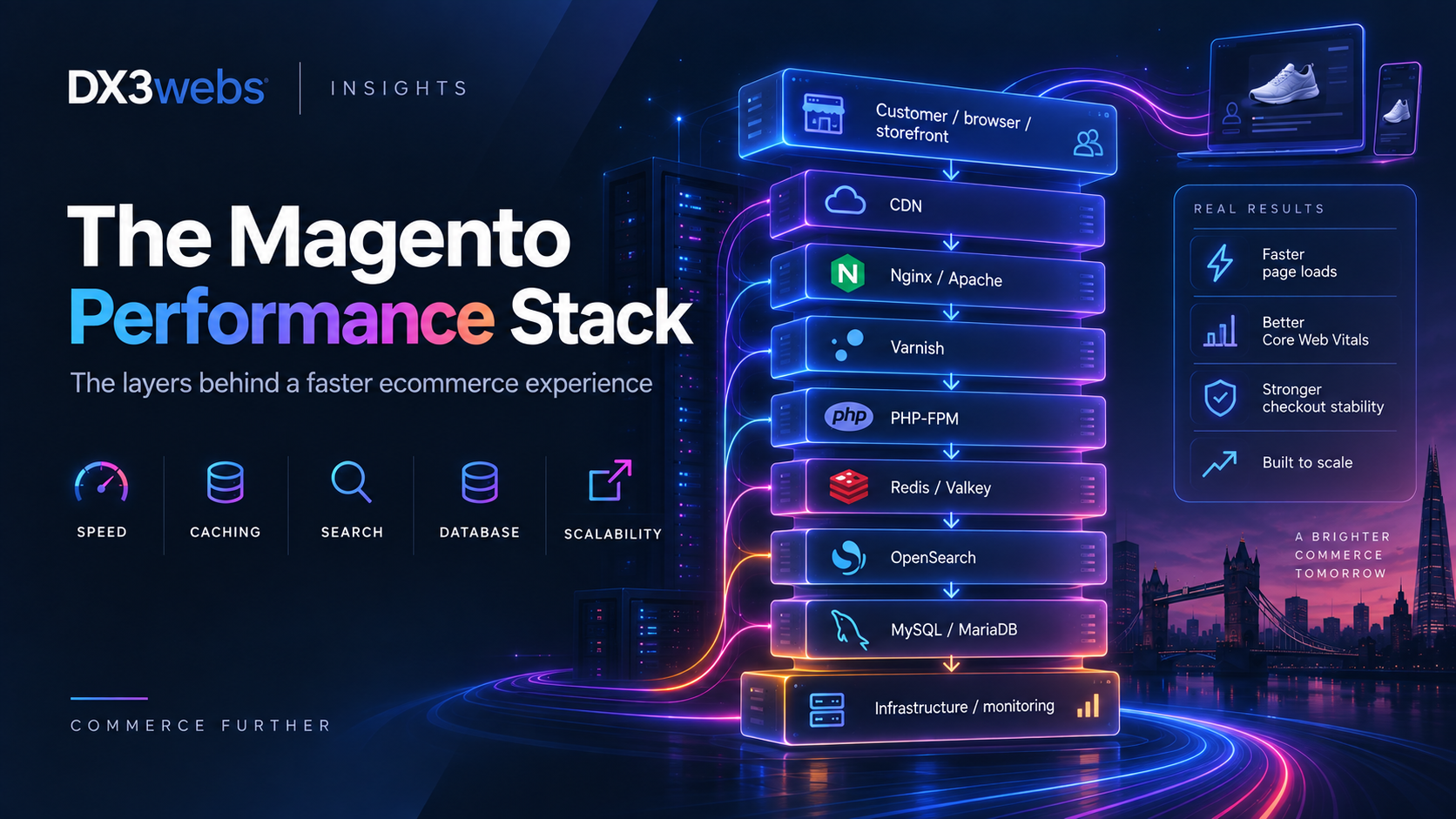
As stores grow in traffic, catalogue size and integration complexity, the importance of an appropriately designed Magento hosting architecture becomes increasingly apparent.
Larger or particularly demanding Magento stores may also benefit from dedicated Magento hosting, where compute, memory, database and search resources can be sized around the requirements of the individual store.
AI does not remove these requirements.
If anything, increasingly sophisticated ecommerce experiences make a strong technical foundation more important.
Why Real User Monitoring matters
Another useful point raised in the performance discussion was the difference between synthetic testing and Real User Monitoring.
Tools such as Lighthouse are extremely useful for identifying performance issues in a controlled environment.
But a laboratory test cannot completely represent what every customer experiences.
Real User Monitoring (RUM) measures the experience of genuine visitors across different devices, network conditions, browsers and locations.
That distinction is important.
The objective shouldn’t simply be to achieve an impressive performance score.
The real objective is to make the customer’s experience faster and more reliable.
Metrics such as Largest Contentful Paint (LCP), Interaction to Next Paint (INP) and Cumulative Layout Shift (CLS) provide useful indicators, but they are most valuable when considered alongside real customer behaviour and application-level monitoring.
Performance is a commercial metric
Performance should not be viewed solely as a technical concern.
A faster site can influence customer experience, conversion, search visibility and the efficiency of paid advertising.
That makes ecommerce performance a commercial metric as well as an infrastructure metric.
A technically impressive AI implementation sitting on top of a slow, unstable Magento store is unlikely to produce the intended result.
Building Magento stores for humans and AI agents
There is an interesting connection between performance, accessibility and agentic commerce.
As automated systems interact more directly with ecommerce stores, websites and APIs need to become increasingly predictable and machine-readable.
Stable interfaces, semantic HTML, accessible content, clear product information, structured data and reliable interactions are good foundations for automated systems.
They are also good foundations for human users.
In that sense, creating an agent-friendly ecommerce site may involve returning to many of the fundamentals of good web development rather than attempting to engineer specifically for whichever AI technology happens to be fashionable.
Fast pages.
Accurate information.
Logical structure.
Predictable behaviour.
Accessible content.
Reliable services.
Those principles are unlikely to become obsolete.
What should Magento and Adobe Commerce merchants do now?
Merchants do not need to rebuild their entire ecommerce operation around AI.
A more useful approach is to make sure the foundations are ready for the changes that are already taking place.
Improve catalogue data
Review product titles, descriptions, attributes, specifications, relationships and categories.
Information that is missing, inconsistent or poorly structured makes product discovery harder regardless of whether the customer is using conventional search or an AI assistant.
Review structured product data
Ensure important product information such as prices, availability, identifiers and other relevant attributes is represented accurately and consistently.
Structured information makes it easier for external systems to interpret what a page represents.
Evaluate ecommerce search
Merchants using Adobe Commerce should be aware of the development of Live Search and semantic search.
Search analytics are also valuable. Look at zero-result searches, customer terminology and searches that fail to lead to products or conversions.
Measure real performance
Don’t rely entirely on occasional Lighthouse tests.
Monitor how actual visitors experience the website and investigate poor LCP, INP or CLS measurements alongside server and application performance.
Keep Magento maintainable
Customisation should solve a genuine requirement rather than simply becoming the default approach.
Where practical, favour extensible architectures, supported APIs and well-defined integrations over unnecessary modification of Magento’s core functionality.
Create genuinely useful content
Product information should answer the questions customers actually have.
Buying guides, comparisons, compatibility information, dimensions, specifications, FAQs and detailed product information can assist conventional SEO, customers and increasingly AI-powered discovery systems.
Integration matters more than individual technologies
Perhaps the biggest takeaway from Meet Magento UK 2026 was that these trends should not be considered independently.
AI depends on good data.
Product discovery depends on well-structured product information.
Personalisation depends on reliable customer data.
Composable commerce depends on sensible extensibility.
Conversational commerce depends on accurate information.
And AI-driven customer experiences still depend on strong performance.
The businesses that benefit most may not necessarily be those that adopt the greatest number of new technologies.
They are more likely to be the businesses that connect the appropriate technologies around a clear customer and commercial objective.
What does this mean for Adobe Commerce merchants?
For Magento and Adobe Commerce merchants, the overall message is relatively practical.
The future of ecommerce is becoming more intelligent, conversational and flexible, but preparing for it does not necessarily mean replacing everything already in place.
Start with the foundations.
Clean catalogue data.
Useful content.
Strong Magento performance.
A sensible technical architecture.
Reliable integrations.
Maintainable development.
From there, semantic search, conversational interfaces and agentic commerce can become genuine opportunities rather than simply another layer of technology to manage.
Meet Magento UK 2026 demonstrated that the next phase of ecommerce is no longer purely theoretical.
Adobe Commerce is already introducing semantic search, AI-driven discovery and infrastructure designed to allow AI agents to interact with live commerce services.
The important question for merchants is therefore becoming less about whether AI will influence ecommerce and more about where these technologies can genuinely improve discovery, customer experience and commercial performance.
How we are using AI at DX3
AI isn’t only changing the customer-facing side of ecommerce. It is also becoming increasingly useful behind the scenes in the way ecommerce platforms are operated and supported.
At DX3, we’re already exploring and using AI-assisted tools to help our engineers analyse logs, identify patterns across large amounts of technical information, investigate performance problems and accelerate troubleshooting.
The important distinction is that we see AI as a tool for experienced engineers rather than a replacement for them.
Magento problems rarely exist in isolation. A slow checkout, for example, might involve PHP, MySQL or MariaDB, Redis, OpenSearch, Varnish, third-party extensions, frontend code or the underlying infrastructure. AI can help process information and highlight relationships more quickly, but understanding whether a suggested conclusion actually makes sense still requires someone who understands the platform.
That combination is where we currently see the greatest value: using AI to give experienced engineers better tools while retaining the human expertise and judgement needed to operate business-critical ecommerce systems.
The same principle probably applies to merchants. The most successful implementations of AI are unlikely to be those that simply replace people or existing systems. They will be the ones that use AI to make good people, good data and good technology more effective.
Frequently asked questions
What is agentic commerce?
Agentic commerce describes ecommerce experiences in which AI agents can participate directly in parts of the shopping journey. This could include discovering products, comparing options, retrieving prices and availability, managing a basket or assisting with checkout.
Adobe Commerce is developing infrastructure and services designed to support these types of interactions.
What is semantic search in Adobe Commerce?
Semantic search uses AI to understand the meaning and intent behind a customer’s search rather than relying solely on exact keyword matches.
Adobe introduced semantic search for supported Adobe Commerce Live Search deployments in June 2026.
This can help customers find appropriate products even when the words they use differ from those contained within the product catalogue.
What is LLM optimisation for ecommerce?
Large Language Model Optimisation, sometimes referred to as LLMO or grouped with Generative Engine Optimisation (GEO), is the process of making content and product information easier for AI-powered systems to understand and use.
For ecommerce businesses this can include complete product data, clear descriptions, structured information, authoritative content and accessible web pages.
Is AI optimisation replacing SEO?
No. AI discovery adds another route through which customers may find products and businesses, but traditional search remains important.
Many good SEO practices — useful content, logical information architecture, structured data, accessible pages and accurate information — are also helpful for AI-powered systems.
Does Magento performance still matter in an AI-driven ecommerce environment?
Yes.
AI-powered search, personalisation and conversational interfaces still depend on an underlying ecommerce platform that responds quickly and reliably.
Customers ultimately need to interact with the store and complete a transaction, making application, database, search, caching, frontend and hosting performance fundamental.
How should Magento merchants prepare for AI shopping agents?
The most useful starting point is not a dedicated AI project.
Merchants should first concentrate on accurate catalogue data, structured product information, reliable APIs, useful content, good site performance and a maintainable Magento architecture.
These provide a stronger foundation for both current ecommerce requirements and emerging AI-driven shopping experiences.