
Choosing ecommerce hosting should not start with a list of server specifications.
A Magento store processing hundreds of orders during a promotion has very different requirements from a large catalogue site with relatively low checkout activity. A WooCommerce store with heavy plugins, scheduled jobs and seasonal peaks can place very different demands on a server from another store receiving exactly the same number of monthly visitors.
Yet hosting is still commonly sold by asking:
How much RAM do you want?
How many CPUs?
Would you like a VPS or a dedicated server?
We think that is backwards.
So we have built something different.
Meet the DX3 Hosting Architect
The DX3 Hosting Architect is a new interactive tool designed to work out what infrastructure an ecommerce store actually needs.
Rather than asking you to choose a server specification, it asks about your store.
Things such as:
- how much traffic the site receives;
- how busy checkout becomes at peak times;
- the size of the product catalogue;
- the number of store views;
- seasonal or promotional traffic increases;
- background processing and scheduled workloads;
- bandwidth requirements;
- and how you expect the business to grow.
The Architect then translates that workload into the infrastructure required to support it.
That may be a managed DX3 cloud platform, dedicated hardware or, for stores with much heavier requirements, a clustered architecture.
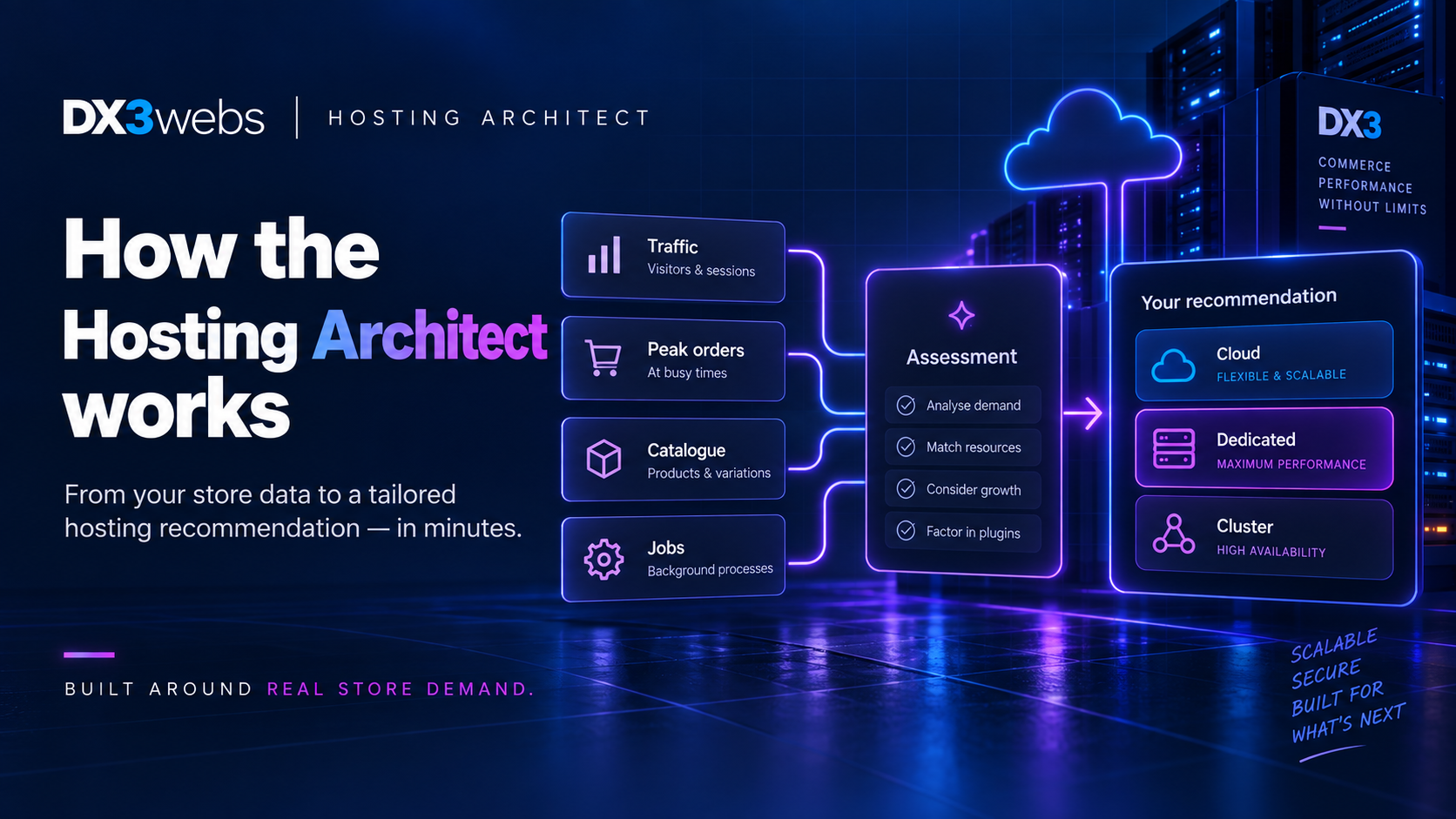
Built around ecommerce workload, not arbitrary server sizes
Magento and WooCommerce do not consume resources evenly.
A page view is not the same as a checkout.
A product catalogue containing 100,000 SKUs places different demands on memory, database and search services from a small catalogue.
A store processing 20 orders an hour normally has very different CPU requirements from one processing 500 orders an hour during a flash sale.
The Hosting Architect therefore considers the different parts of the workload independently.
For Magento, for example, CPU requirements can be influenced by:
PHP workers. Checkout processing. Database activity. Search. Background queues. Platform overhead.
Memory requirements are also affected by catalogue size, concurrency, store views and the number of processes that need to run simultaneously.
The aim is not simply to produce a bigger number.
It is to recommend an architecture with enough headroom to perform properly without selling infrastructure that the store does not need.
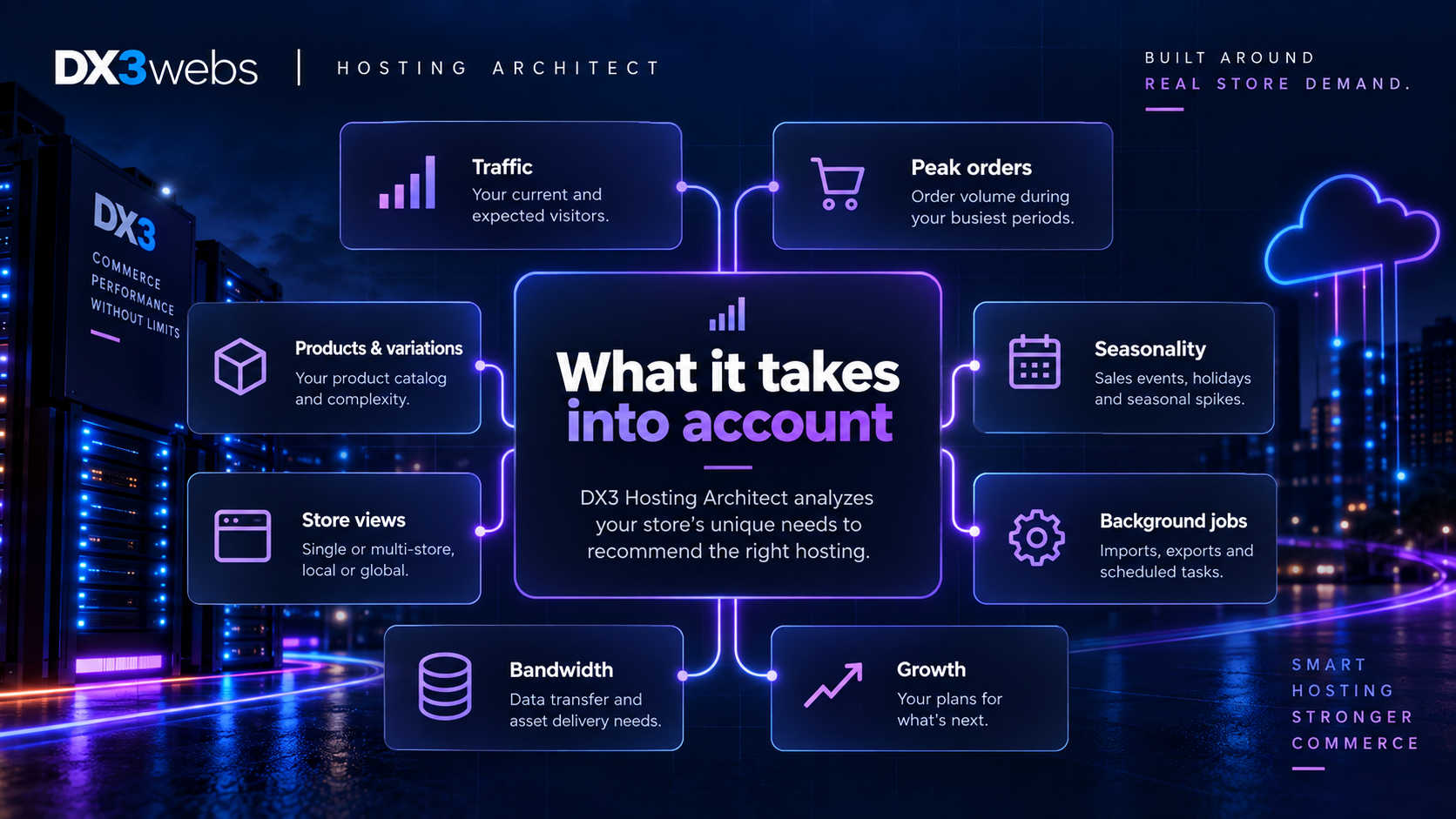
Cloud, dedicated or cluster?
There is no single correct hosting architecture for every ecommerce business.
For many growing stores, managed cloud hosting provides the best combination of performance, resilience and the ability to scale.
Other workloads make more sense on dedicated hardware.
Very large or extremely transactional stores may need to separate web, database, search and background workloads across multiple systems.
The Architect considers those differences before making its recommendation.
And if the calculated requirements move beyond a sensible standard configuration, it will tell you that the store needs individual review rather than pretending that an off-the-shelf plan is suitable.
Magento and WooCommerce are treated differently
One of the reasons we built the tool ourselves is that Magento and WooCommerce are not interchangeable workloads.
They may both run ecommerce stores, but their infrastructure requirements can be very different.
The Hosting Architect therefore has separate sizing logic for:
Magento / Adobe Commerce
and
WooCommerce
rather than feeding both platforms through the same generic hosting calculator.
Why we built it
DX3 has specialised in ecommerce hosting since 2009.
Over that time we have seen plenty of stores placed on infrastructure that was either:
too small, causing slow checkout, overloaded PHP workers, database contention and poor performance during peaks;
or:
far larger than necessary, leaving the merchant paying for resources they were never going to use.
Neither is a good outcome.
Our approach has always been to provide enough infrastructure to deliver a fast, reliable store while avoiding unnecessary cost.
The Hosting Architect is an attempt to make that approach visible before someone even becomes a DX3 customer.
It is a recommendation, not a sales trick
The result is intended to give you a sensible starting point.
If a standard DX3 platform fits the workload, the Architect will show it.
If dedicated infrastructure makes more sense, it will say so.
And if the workload is sufficiently large or unusual that we think it deserves proper architecture work, it will recommend a conversation with us instead.
That is much more useful than forcing every store into the nearest predefined hosting package.
Already running on AWS, Google Cloud or another host?
The Architect can also be useful if you already have hosting.
Run your existing store through it and compare the resulting architecture with what you currently have.
In particular, it is worth comparing the whole operating model, not just the headline cost of a virtual machine.
That means considering:
Compute. Storage. Traffic. Backups. Monitoring. Security. PCI. Management. Support.
A platform that appears cheaper at the infrastructure level can look very different once the services required to operate it properly are included.
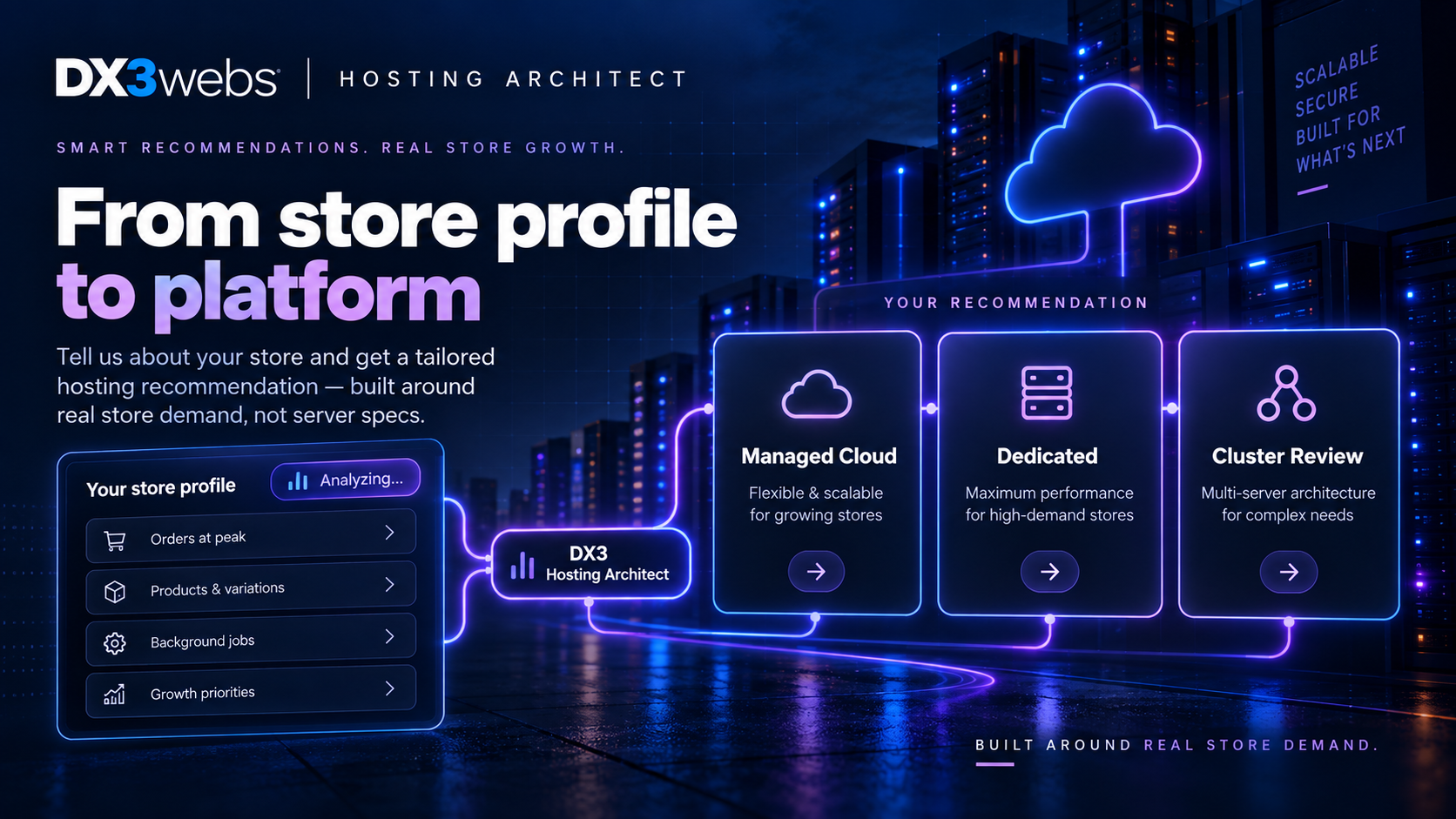
Try the Hosting Architect
The first version of the DX3 Hosting Architect is now live.
Choose your platform, tell us about the way your store operates and see what infrastructure the Architect recommends.
Magento / Adobe Commerce or WooCommerce.
Cloud, dedicated or cluster.
Sized around the store rather than the server catalogue.