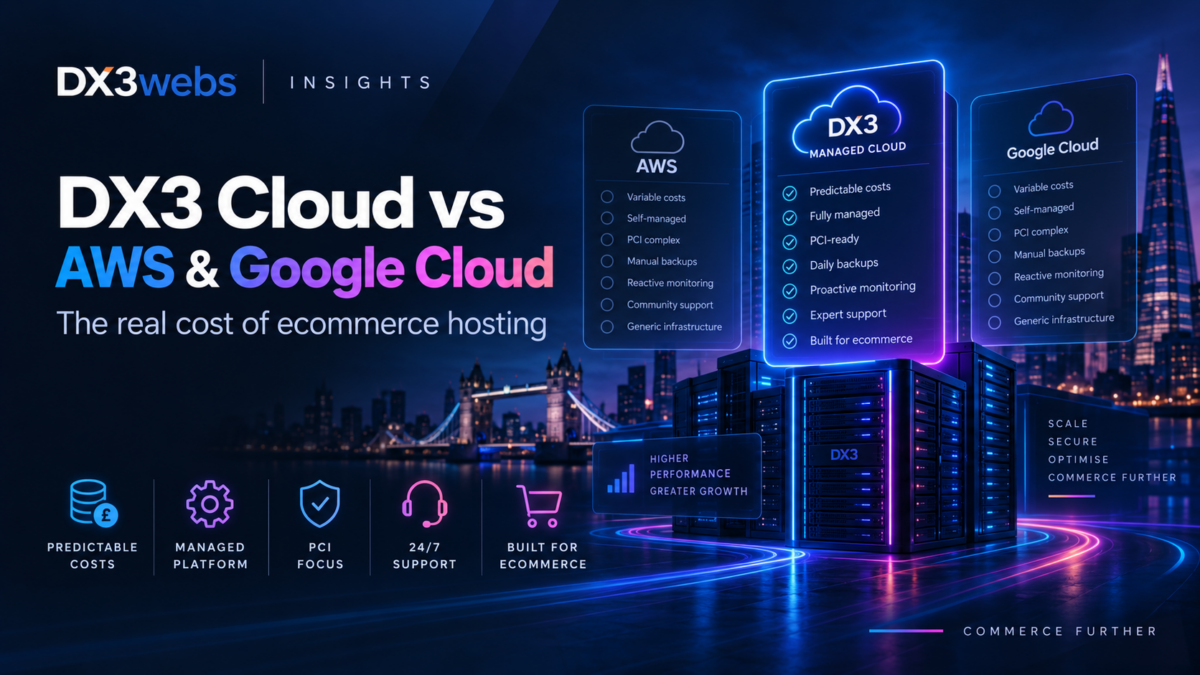
£1,500/month managed private cloud vs an indicative £3,000+ AWS infrastructure bill
When businesses compare managed hosting with AWS, it is very easy to compare the wrong numbers.
An AWS instance has a price.
So does a DX3 cloud server.
But those two prices do not necessarily buy the same thing.
To illustrate the difference, we modelled what one of the larger ecommerce platforms we operate would look like if its existing infrastructure were moved onto AWS.
The customer was a substantial international ecommerce operation serving multiple markets and storefronts.
The result illustrates why businesses need to compare the total cost of operating the platform, rather than simply comparing CPU and RAM.
The existing DX3 environment
This platform is considerably larger than a typical single-server Magento installation.
The estate provides approximately:
100 logical CPU threads
~128GB RAM
across multiple servers.
The infrastructure supports several international storefronts, including the UK, .com and European operations.
The current cost of the DX3 infrastructure and routine server-level management is approximately:
£1,500 per month ex VAT
Application development and Magento development support are separate from this figure.
The £1,500 covers the underlying hosting platform together with the routine infrastructure work required to keep it operating.
That distinction becomes important when comparing it with public cloud pricing.
Modelling an AWS equivalent
For the AWS comparison, we modelled a relatively straightforward three-server deployment in AWS London.
The proposed AWS platform used:
3 × c7a.8xlarge
Each instance provides approximately:
- 32 vCPU
- 64 GiB RAM
Giving the platform:
96 AWS vCPUs
192 GiB RAM
We allowed approximately:
500GB of gp3 SSD storage per server
and assumed the instances were operating continuously.
This was deliberately not an unnecessarily complicated AWS architecture.
It was simply an attempt to reproduce approximately the computing resources required by the existing ecommerce platform.
The AWS compute bill
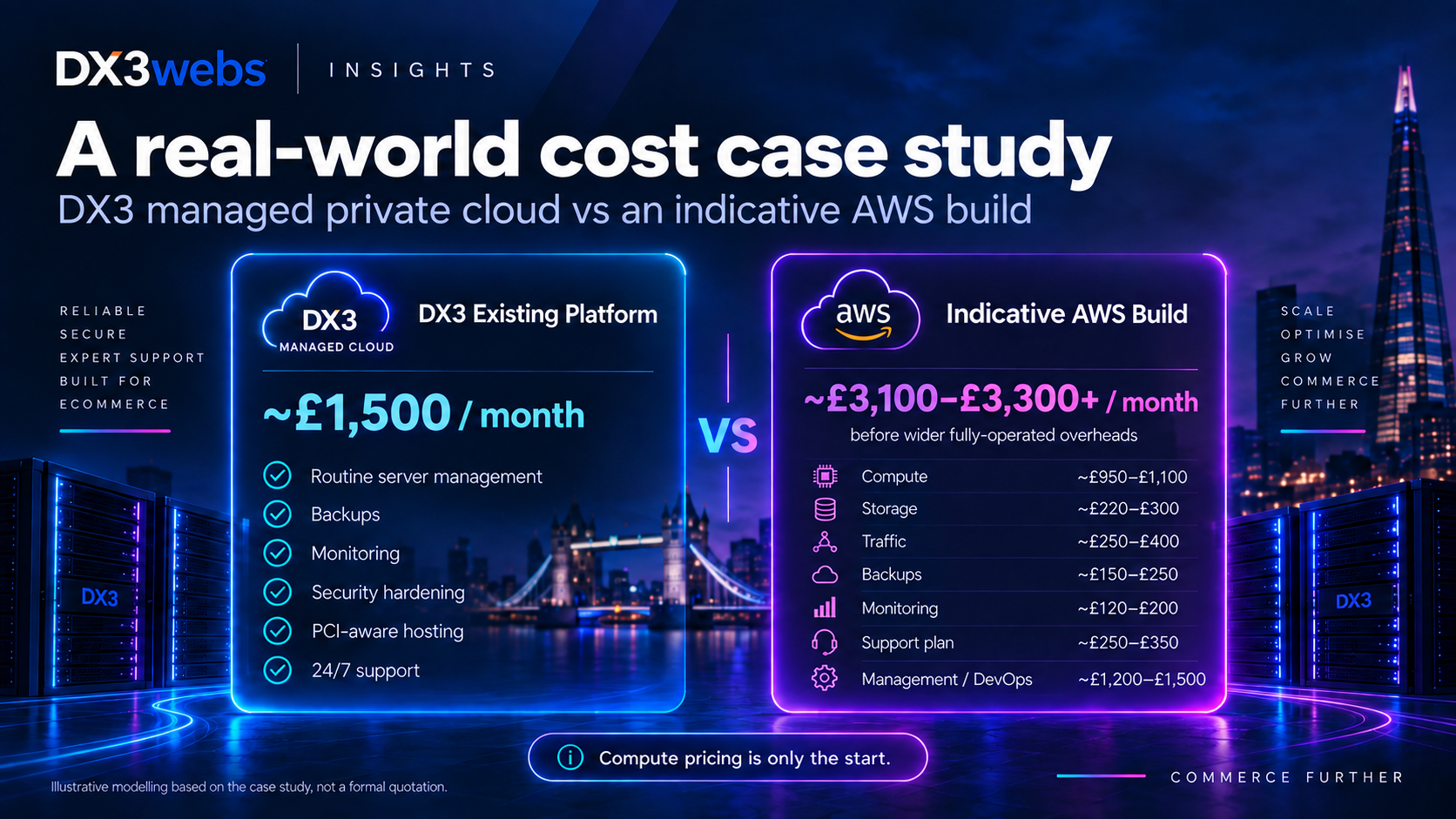
At the pricing used for the comparison, the three instances were approximately:
$3,596 per month
Storage added approximately:
$183 per month
Giving a basic infrastructure total of around:
$3,779 per month
or approximately:
£2,826 per month ex VAT
And that is before significant network traffic, backup storage and many other production services are considered.
Add real ecommerce traffic
We then allowed for approximately 4TB of monthly outbound traffic.
Cloudflare may substantially reduce origin bandwidth, so exact traffic charges would depend on the final architecture.
Nevertheless, once realistic network usage was included, our indicative AWS cost moved towards approximately:
£3,100–£3,300 per month ex VAT
Already more than twice the existing DX3 monthly cost.
But there was still an important problem.
We had largely only bought the infrastructure.
AWS does not administer your Magento server for you
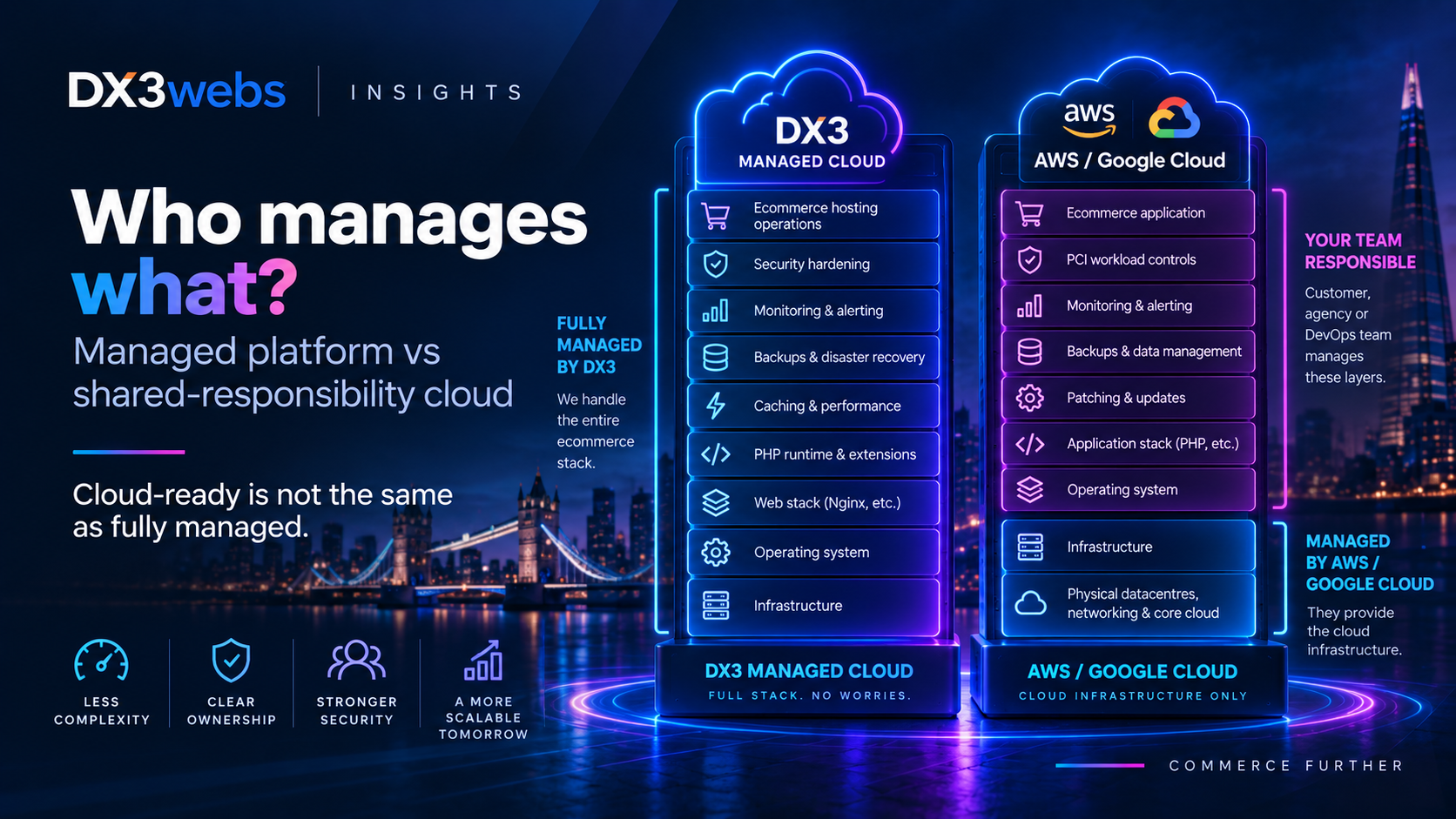
Running an EC2 instance does not automatically provide the operational services currently included with the DX3 platform.
Someone still needs to manage:
- Linux
- security updates
- PHP
- Nginx/Apache
- MariaDB/MySQL
- Redis
- Varnish
- Elasticsearch/OpenSearch
- disk utilisation
- SSL
- firewalling
- backups
- monitoring
- log management
- capacity planning
- vulnerability remediation
- PCI-related server configuration
- incident response
AWS operates the underlying cloud.
The customer remains responsible for much of what happens inside an EC2 instance.
That work therefore has to be performed either by the customer’s own team, an agency, a DevOps engineer or a managed-service provider.
The production AWS cost
Once we began allowing for the wider production environment, costs could also include:
- snapshot and backup storage
- monitoring
- CloudWatch usage
- public IPv4 addresses
- load balancers
- inter-zone traffic
- additional storage
- enhanced AWS support
- database services
- Redis services
- OpenSearch
- managed infrastructure support
Depending on how much of the environment was converted to native AWS services and how much management was outsourced, we estimated that a realistic fully operated AWS environment could move towards:
£4,000–£6,000+ per month ex VAT
That is not because AWS is expensive or badly priced.
It is because AWS is selling something fundamentally different.
AWS provides an extraordinarily capable infrastructure platform.
DX3 provides an operated ecommerce hosting platform.
Could AWS Reserved Instances reduce the cost?
Absolutely.
AWS pricing can be substantially reduced by committing to infrastructure for longer periods.
Our modelling suggested an approximate infrastructure cost of:
1-year commitment: £2,200–£2,700/month
and potentially:
3-year commitment: £1,700–£2,300/month
depending on the precise commitment model and services selected.
Those figures are much closer to the DX3 price.
But there are two important differences.
Firstly, those numbers still do not automatically include the people required to operate the environment.
Secondly, achieving the lowest prices means making a substantial long-term commitment to that AWS architecture.
The existing DX3 platform is approximately:
£1,500/month
without requiring the customer to become a cloud infrastructure operator.
What happens if your solution architect disappears?
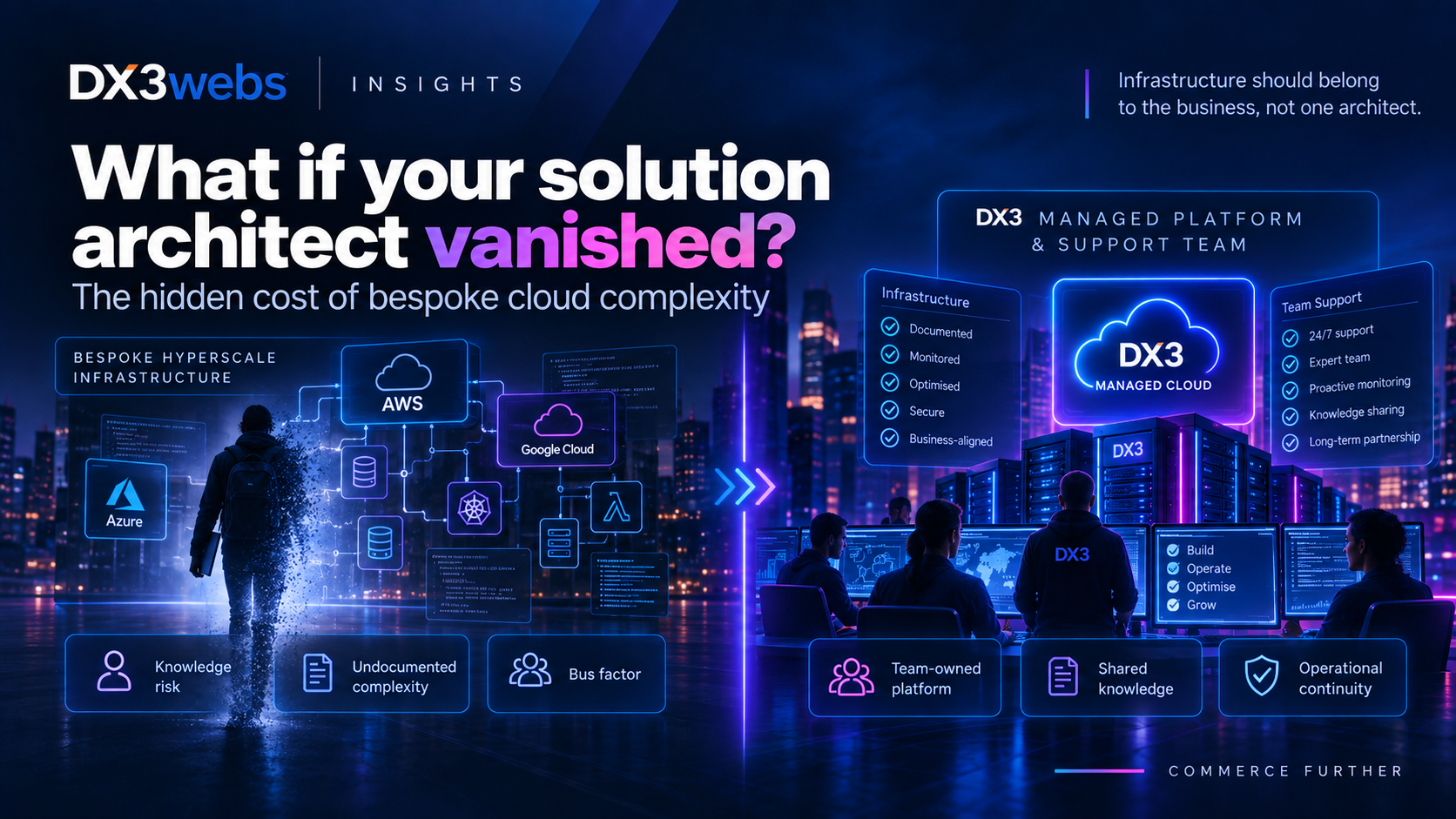
There is another infrastructure cost that does not appear on an AWS calculator.
Knowledge.
A sophisticated AWS environment needs somebody to design it.
That person decides:
- how VPCs are structured
- how subnets are divided
- which Availability Zones are used
- how security groups operate
- how IAM permissions are structured
- where databases live
- how backups work
- how traffic reaches the application
- how load balancing works
- how autoscaling behaves
- where logs are stored
- how alerts are generated
- how deployments happen
- how disaster recovery works
Add Terraform, Kubernetes, Lambda, RDS, ElastiCache, OpenSearch, CloudWatch and other AWS services and the infrastructure can become extremely capable.
It can also become extremely specific.
Then something surprisingly common happens.
The person who designed it leaves.
Perhaps the employee changes jobs.
Perhaps the DevOps engineer moves on.
Perhaps an external consultant is no longer available.
Perhaps the agency relationship ends.
Perhaps the architect is simply on holiday when something breaks.
The servers haven’t disappeared.
The AWS account hasn’t disappeared.
But a significant amount of the knowledge required to understand the system may have.
The £100,000 architecture nobody wants to touch
This is one of the less discussed risks of highly bespoke infrastructure.
Over several years a cloud environment can accumulate:
- scripts
- Terraform definitions
- IAM policies
- security groups
- custom deployment systems
- Lambda functions
- unusual routing
- undocumented exceptions
- monitoring rules
- automatic scaling logic
- legacy resources nobody is quite sure about
Eventually the business can become dependent on a surprisingly small number of people who know why it all exists.
When one of those people disappears, the next engineer may have to reverse-engineer the platform before they can safely make changes to it.
That has a cost.
And, during an outage, it has a potentially significant business impact.
The bus-factor test
There is a simple question businesses should ask about their hosting platform:
If the person who designed this infrastructure disappeared tomorrow, who could operate it?
If the answer is one person, the business has an infrastructure risk.
This is sometimes described as the bus factor — the number of people who could become unavailable before essential knowledge about a system was lost.
For critical ecommerce infrastructure, a bus factor of one is uncomfortable.
DX3’s approach is deliberately different
The environment is not based around one DX3 engineer’s personal architecture.
It uses technologies our team operates every day across many ecommerce platforms:
- Linux
- Nginx
- Apache
- PHP
- MariaDB/MySQL
- Redis
- Varnish
- Elasticsearch/OpenSearch
- HAProxy
- established monitoring
- established backup systems
There may still be complexity.
Magento itself is not exactly famous for being simple.
But that complexity is operated by a team, rather than being dependent upon one customer’s solution architect.
If one DX3 engineer is unavailable, another engineer can work on the platform.
The customer isn’t employing us merely for access to CPU and RAM.
They are buying access to the operational knowledge surrounding the platform as well.
PCI creates the same distinction
AWS operates a PCI DSS compliant cloud platform and provides extensive tools for organisations building PCI environments.
But using AWS does not automatically make an ecommerce deployment PCI compliant.
The customer remains responsible for significant elements of the workload under AWS’s shared-responsibility model.
That includes areas such as operating-system configuration, security updates, applications and access controls.
DX3 approaches the problem from the other direction.
We operate as a PCI DSS service provider, and the ecommerce infrastructure itself is managed with those requirements in mind.
That does not remove the merchant’s own PCI responsibilities.
The Magento application, payment integrations, developers, business processes and merchant configuration still matter.
But the merchant is not starting with an empty EC2 instance and being told:
“Good luck making that PCI compliant.”
There is already an infrastructure team responsible for operating the hosting layer.
Cost comparison
| DX3 Existing Platform | AWS Indicative Build | |
|---|---|---|
| CPU capacity | ~100 logical threads | 96 vCPU |
| RAM | ~128GB | 192GB |
| Architecture | Multi-server | 3 × c7a.8xlarge |
| SSD | Included within platform | ~1.5TB gp3 modelled |
| Basic monthly infrastructure | ~£1,500 | ~£2,826 |
| Approx. with 4TB traffic | ~£1,500 | ~£3,100–£3,300 |
| Server management | Included | Additional responsibility |
| Monitoring | Included | Configure/manage |
| Backups | Included | Configure/store/manage |
| OS/security maintenance | Included | Customer/partner responsibility |
| Magento infrastructure expertise | Included | Customer/partner responsibility |
| PCI hosting environment | Managed by PCI service provider | Customer designs/manages workload compliance |
| Indicative fully-operated cost | ~£1,500 | potentially £4,000–£6,000+ |
AWS figures are indicative modelling rather than an AWS quotation. Actual costs depend on architecture, reservations, traffic, services, exchange rates and support arrangements.
What did the comparison actually tell us?
The conclusion was not that AWS is bad.
Far from it.
AWS is an extraordinary engineering platform.
If this customer needed hundreds of microservices operating across several continents, massive Kubernetes clusters, serverless event processing or deep integration with AWS’s enormous service catalogue, it could be exactly the right platform.
But that isn’t the problem we’re trying to solve.
The problem is:
How do we reliably operate a large ecommerce platform?
For this particular workload, our modelling suggested that moving to AWS could mean paying considerably more for the infrastructure while simultaneously taking on greater responsibility for operating it.
That doesn’t represent particularly good value simply for the privilege of putting an AWS logo on an architecture diagram.
Private cloud can still be cloud
There is sometimes an assumption that moving to AWS or Google Cloud automatically represents an infrastructure upgrade.
That is too simplistic.
The important questions are:
Does the platform have sufficient resources?
Can it scale when required?
Is it resilient?
Is it secure?
Is it monitored?
Is it backed up?
Can somebody fix it when it breaks?
And what does the whole thing actually cost?
DX3’s private cloud allows us to allocate resources to customer environments and increase CPU and RAM when workloads require it.
For events such as Black Friday, additional resources can be allocated rather than permanently paying for peak capacity throughout the year.
The technology exists to serve the ecommerce business.
The ecommerce business doesn’t exist to justify the cloud architecture.
£1,500 vs potentially £4,000–£6,000 isn’t the whole story
The financial comparison is striking.
But arguably the bigger difference is responsibility.
With a hyperscale public cloud model the conversation often starts:
“Here are your cloud resources. How would you like to architect them?”
Our conversation starts somewhere else:
“Here’s your ecommerce platform. We’ll look after the infrastructure.”
For many ecommerce businesses, that distinction is worth considerably more than a few pounds per virtual CPU.
Thinking about moving Magento to AWS?
Before migrating, compare the entire operating model rather than just the cost of EC2 instances.
Give DX3 your proposed AWS or Google Cloud specification—or even your existing monthly cloud bill—and we’ll compare it against an equivalent managed DX3 platform.
Compute. Storage. Traffic. Backups. Monitoring. Security. PCI. Management. Support.
Then you can compare the numbers that actually matter.
Already running Magento on AWS?
It may be worth making the comparison from the other direction too.
If your Magento platform is already on AWS, you may be paying for far more than just compute: storage, snapshots, bandwidth, monitoring, support plans, managed services and the internal or external DevOps resource required to keep everything running.
For some businesses, that complexity is justified.
For others, it may simply mean paying a premium to operate an ecommerce platform on infrastructure that was designed to solve much broader problems.
DX3 can review your current AWS estate and map it against an equivalent managed platform.
That comparison can highlight opportunities to:
- reduce monthly infrastructure spend
- remove unnecessary cloud complexity
- bring server management, monitoring and backups under one service
- simplify PCI-related operational responsibilities
- reduce reliance on individual cloud specialists
- make costs more predictable
- retain the performance and scalability Magento actually needs
If your AWS environment has grown organically over time, includes services nobody is quite sure are still required, or depends heavily on one architect or agency, there may be significant value in simplifying it.
You do not necessarily need to re-engineer Magento.
Sometimes you just need to put it on a platform that is built, managed and supported for ecommerce.
Send us your AWS bill, architecture diagram or current server specification and we’ll show you what the equivalent DX3 platform would look like — and where the savings may be.